
San Francisco Projected vs Actual Release
A projected release date is a current calculation, not a promise that a person will walk out at that exact time. In California state-prison cases, CDCR and BPH use terms such as Earliest Possible Release Date, Minimum Eligible Parole Date, Nonviolent Parole Eligible Date, Youth Parole Eligible Date, Elderly Parole Eligible Date, and controlling parole eligible date. Some dates are release calculations. Others are hearing or review eligibility dates.
For a San Francisco County jail case, the Sheriff and court record control the local timeline. A person held pretrial may be released by a judge, bail decision, own-recognizance order, dismissal, sentence credit, or warrant clearance. A person sentenced to a local jail term may have conduct or work credits under California Penal Code section 4019. A person sentenced to CDCR leaves the local jail release-date problem and moves into state case-record calculations.
Scheduled vs actual: A scheduled date can shift before release if credits change, another warrant appears, a detainer controls, a court order changes, or agency review is not complete.
Find a San Francisco Release Date
The fastest path is to identify the source that has legal control over the person. San Francisco County has a live jail search and court records, but it does not publish a separate official release-date calculator for local jail sentences. CDCR has CIRIS and BPH date terms for state-prison commitments. Court records tie the calculation back to the sentence, disposition, and case number.
- Use the San Francisco County released inmate lookup path to decide whether the person is in local jail, CDCR, federal custody, or only appears in a court file.
- For a current county-jail detainee, search by name, SF number, or booking number on the Sheriff's "Find a person in jail" page, then compare the result with the court case.
- For a state-prison commitment, search CDCR CIRIS by CDCR number or name, then confirm commitment county and admission date.
- Check BPH records when the case involves parole eligibility, suitability hearings, nonviolent parole review, youth offender parole, or elderly parole.
- Use VINELink Check for release or transfer alerts, then confirm formal details with the court, Sheriff, or CDCR.
The date source should be saved with its context. A CIRIS detail, a court minute order, a VINE notice, and a family statement are not equal records. Match the court number, CDCR number, SF number, booking number, and facility whenever possible.
CDCR Dates for San Francisco Commitments
For a San Francisco County defendant sentenced to CDCR, CIRIS is the public state-prison search. CA.gov describes CIRIS results as including name, CDCR number, age, current location, commitment counties, admission date, and Board of Parole Hearing dates and outcomes for people currently in CDCR custody. The commitment county field is important because the person can be held anywhere in California while the criminal case came from San Francisco County.
| CDCR or BPH field | What it means for release date work |
|---|---|
| EPRD | Earliest Possible Release Date for many determinate sentences after applicable credits. |
| MEPD | Minimum Eligible Parole Date for life-with-parole cases. |
| NPED | Nonviolent Parole Eligible Date for eligible Proposition 57 cases. |
| YPED | Youth Parole Eligible Date when the youth offender parole process applies. |
| EPED | Elderly Parole Eligible Date when that review path applies. |
| Controlling parole eligible date | The earliest applicable opportunity for parole consideration or release. |
The CA.gov CIRIS service description is a useful source for the public fields, while BPH's parole eligibility material explains why a visible date may be a hearing opportunity rather than a guaranteed exit.
The manifest includes a capture of the CIRIS entry point from CDCR CIRIS.
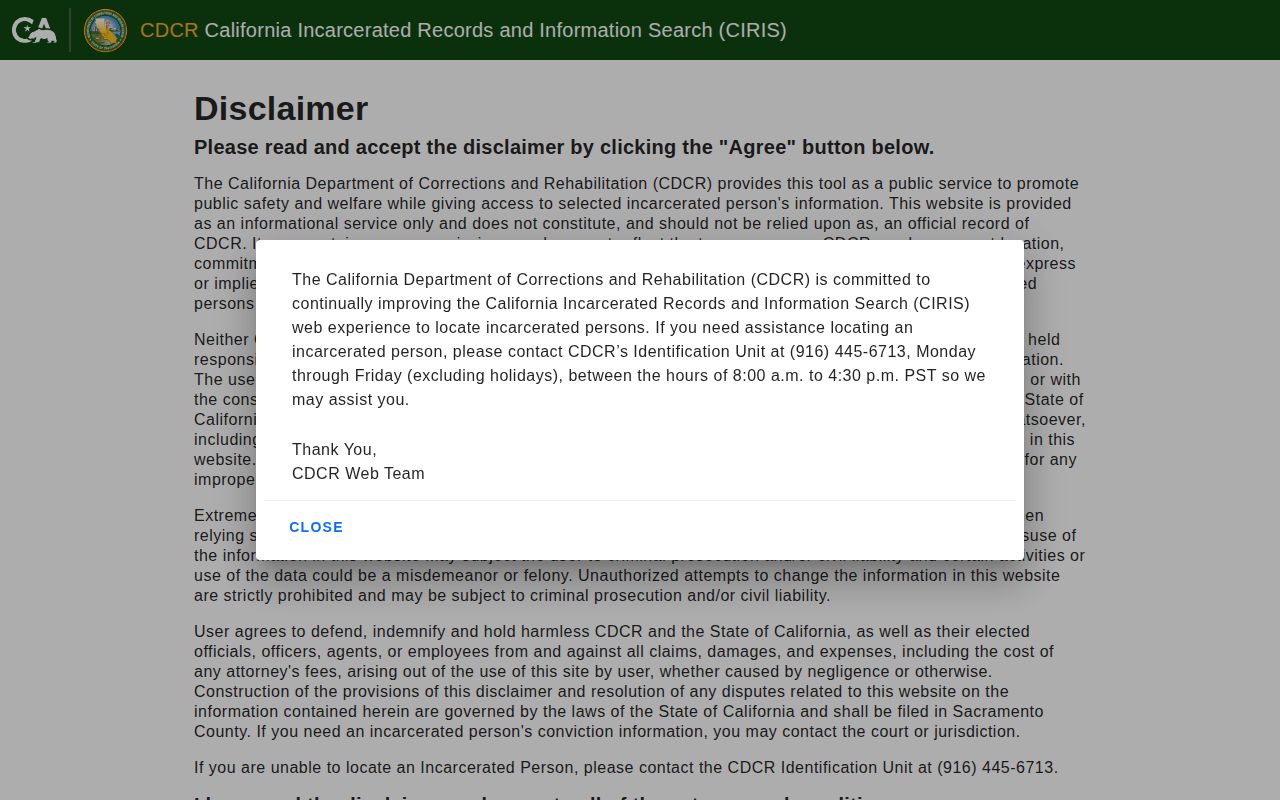
Use CIRIS for state-prison commitments. Do not use it as the first stop for someone who was booked and released only from a San Francisco county jail.
California Credits and Release Dates
California good-time and earned-time rules depend on custody type and sentence type. Penal Code section 2933 addresses state-prison worktime credits. Penal Code section 2933.1 caps credits for qualifying violent felonies at no more than 15 percent, which is the practical source of the common 85 percent service concept. Penal Code section 2933.3 adds enhanced credits for some conservation camp and firefighter assignments.
County-jail credits are different. Penal Code section 4019 applies to many local custody contexts, including county jail, and describes conduct and work credits with exceptions. A San Francisco county-jail sentence should not be described as a CDCR EPRD. The local calculation can include actual days, pre-sentence credit, conduct/work credit, time served, court orders, and holds.
CDCR's resentencing and release information describes a pre-release review that includes court orders, other commitments, notifications, release funds, and holds, warrants, or detainers that may supersede a release order.
Why San Francisco Dates Change
A San Francisco County projected release date can change for lawful reasons before the person is released. Some changes are math-based, such as credits earned or lost. Others come from courts and agencies, such as a new order, a warrant from another jurisdiction, or a detainer. A parole-review case can change because a hearing is granted, denied, postponed, continued, or still subject to legal review.
| Change factor | How it affects the date | Best source |
|---|---|---|
| Good-time or work credit | May reduce the served term when the person qualifies. | CDCR case records or local court/Sheriff calculation |
| Discipline or credit loss | May move the projected date later. | CDCR or local custody records |
| Court order | May release, remand, resentence, dismiss, or change custody. | San Francisco Superior Court |
| Warrant, hold, or detainer | May block physical release after one case is cleared. | Sheriff, CDCR, court, or holding agency |
| Parole hearing result | May create a review path, but a grant is not always immediate release. | Board of Parole Hearings |
Note: If the person disappears from the local jail search, confirm whether the event was release, transfer, court movement, CDCR commitment, or another custody hold.
San Francisco Late-Night Release Timing
San Francisco has a local timing rule that affects when a projected release becomes a physical exit. The Sheriff's late-night release page says people cleared for release between 6 p.m. and 5 a.m. may choose to delay release until daytime business hours begin. The person can change their mind and may remain up to 16 more hours or until daytime business hours, whichever is shorter.
This rule is not a sentence-credit formula. It does not change the sentence, EPRD, court order, or CDCR calculation. It matters because a family member may hear that the person is cleared, while the person has chosen not to leave during the late-night window. For pickup planning, the voluntary late-night release deferral page should be read with the Intake and Release Center instructions.
Timing caution: A person can be legally cleared before the physical pickup happens, especially when the late-night deferral option is used.
Confirm a San Francisco Release Date
Confirmation should follow the custody path. For San Francisco jail custody, use the Sheriff's current person search, the public information line, the court case, VINE, and records request fallback. For CDCR custody, use CIRIS, BPH material when relevant, DAPO after release to state parole, and San Francisco Adult Probation if PRCS applies. For federal custody, BOP or ICE records are separate and should not be mixed with the county jail record.
VINELink is useful when a release or transfer alert matters. It can notify registered users when custody status changes, but it is not the full court file. For certified disposition or sentence information, San Francisco Superior Court records are stronger than a notification. For a historical booking or release event, a public-record request to the Sheriff's Office may be needed after the live jail search no longer shows the person.