
San Francisco 72-Hour Release Window
No official San Francisco Sheriff's rolling 72-hour recent-release feed was found. The sources reviewed show a current person lookup, VINE release-notification links, jail release process pages, court record channels, and public-record request routing. They do not show a page that lists every person released over the last three days.
The 72-hour intent is different from the 24-Hour Release List page. A same-day check asks whether a release just happened. A three-day check tries to catch releases that may have happened during a weekend, overnight clearance period, court calendar gap, or delayed pickup situation. In San Francisco, the official path still depends on matching a person to the right agency record.
Check San Francisco 72-Hour Releases
A three-day check should preserve the timeline. Record the date and time of each source checked, because a court calendar, a VINE notice, and a jail search result can update at different speeds. Keep identifiers together: name spelling, date of birth if known, SF number, booking number, court case number, and facility.
- Run the Sheriff's Find a person in jail search by name, SF number, or booking number.
- Search California VINELink for a custody-status result or notification option tied to the person.
- Review the San Francisco Superior Court Criminal Division pages when release depends on arraignment, bail, dismissal, sentence completion, or probation action.
- Use the Sheriff's public information line, 415-553-1430, when the official VINE fallback instructions route custody questions there.
- File a public-record request for the booking or release record when the online trail does not show the release event clearly.
- Switch to CDCR, BOP, or ICE only if the case moved from local San Francisco custody to state, federal, or immigration custody.
San Francisco 72-Hour Fields
Since there is no official three-day feed, the fields below describe the official San Francisco release-adjacent fields that can support a 72-hour check. They should be read as source fields, not as columns in a published 72-hour roster.
| Field | Source and use |
|---|---|
| Name | The Sheriff's search accepts name input using the first three letters of first name and last name. |
| SF number | A permanent San Francisco County Jail identifier that can reduce confusion across bookings. |
| Booking number | The strongest local jail reference for a release-record request or VINE and court comparison. |
| Total Bond | A bail clue from the Sheriff's Buffin page when a court has set bail. |
| Court case number | Needed for court calendars, criminal case query, certified disposition, and sentence records. |
| Release or hold reason | May involve own recognizance, bail, dismissal, sentence completion, warrant, hold, detainer, or transfer. |
The Sheriff's VINE page is a better match for release notifications than a three-day list because it is built around custody-status changes.
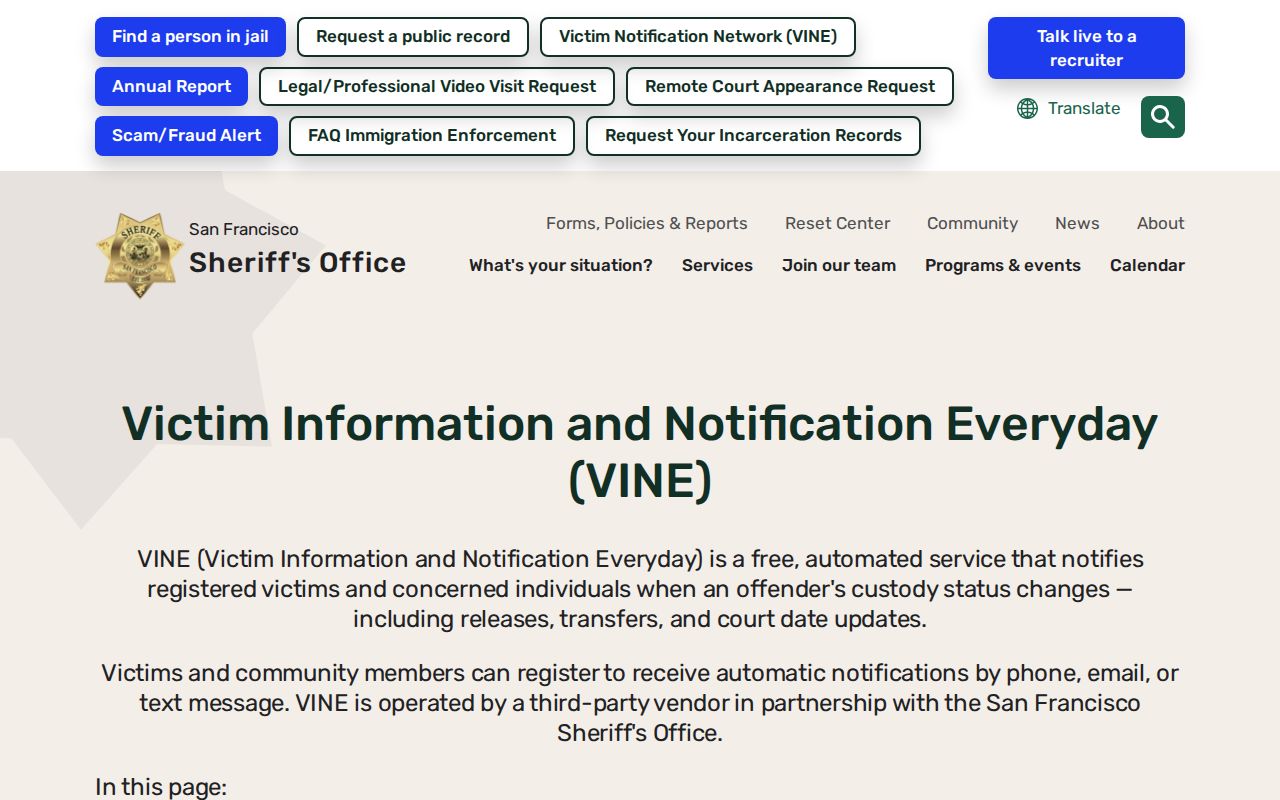
The source is relevant to a 72-hour check because VINE can preserve a custody-change notice when a current jail search no longer shows the person.
Weekend Release Lag
The three-day window matters most when the release timeline crosses a weekend, holiday, court day, or overnight period. A person may be cleared by a judicial officer, have a VINE event, or stop appearing in a current search before a family member sees the person leave custody. In San Francisco, the Intake and Release Center and court process can both shape that timeline.
Late-night release adds another layer. The Sheriff's late-night release page says people cleared between 6 p.m. and 5 a.m. may delay release until daytime business hours begin and may remain up to 16 more hours or until daytime business hours, whichever is shorter. That makes a rigid three-day "released list" expectation unreliable unless the source identifies the exact event and timestamp.
Bail timing is also local. The Sheriff's Buffin page says the office stopped using the old Superior Court felony and misdemeanor bail schedule to release people from jail. A judicial officer may set bail before, during, or after arraignment, so a three-day check should read jail status and court action together.
Note: When a release appears to fall near a weekend or holiday, check the court event and the custody source before planning around the time.
DataSF Release List Limits
The DataSF Sheriff Jail Bookings dataset is not a 72-hour release list. Its metadata describes monthly aggregate booking data since 2012 by demographic categories. It groups small categories to reduce re-identification risk and updates monthly, so it cannot identify who left custody in the last three days.
Use DataSF only as background about booking data. For a person-level question, the correct official sources are the Sheriff search, California VINE, court records, CDCR for state-prison cases, BOP for federal cases, ICE for immigration custody, and a records request for historical documentation.
| Source | 72-hour value | Limit |
|---|---|---|
| DataSF jail bookings | Shows aggregate booking context | Monthly, grouped, not person-level release data |
| Sheriff person search | Checks current local custody | Not an archive of released people |
| VINE | Shows or sends custody-change notices | Not a full court disposition record |
| Superior Court | Shows legal reason for release | Does not operate the jail roster |
Request a Three-Day Record
When the three-day check is about proof, use the record process. The Sheriff's public-record request page is the official fallback for historical booking and release records when the online search is not enough. The request should be narrow and source-based, such as the release date, release type, booking sheet, custody status, or release/discharge event for a named booking.
Include the full name, date of birth if known, SF number, booking number, approximate arrest or booking date, facility if known, court case number if known, and the specific record requested. Ask for segregable nonexempt portions if part of the record is withheld. Do not assume the agency will create a new 72-hour list; request the existing record tied to the person or booking.
Released or Moved Elsewhere
A three-day search often fails because the custody type changed. A San Francisco county-jail release can mean release to the community, release to electronic monitoring, transfer to CDCR, transfer under a warrant, hospital movement, court custody, federal custody, or an immigration-custody issue. Each path has a different official record.
- County release
- Use the Sheriff, VINE, court records, and a Sheriff records request.
- State-prison transfer
- Use CDCR CIRIS, CDCR records, parole channels, and the San Francisco court judgment.
- Federal custody
- Use the BOP inmate locator when the person is in federal criminal custody.
- Immigration custody
- Use ICE channels when the person is in federal immigration custody, while keeping San Francisco's local release policy separate.