
San Francisco Parole vs Probation
Post-release supervision in San Francisco County is not one system. A person released from the San Francisco Intake and Release Center or a county jail may be on local probation, pretrial electronic monitoring, sentenced electronic monitoring, or no supervision at all. A person released from California Department of Corrections and Rehabilitation custody may be on state parole through the Division of Adult Parole Operations, or may be returned to the county for Postrelease Community Supervision.
The key point is source control. A county jail result may show that the person left custody, but it usually does not prove whether supervision has ended. The durable record may be in the court case, CDCR/CIRIS, the Board of Parole Hearings, DAPO, San Francisco Adult Probation, or a Sheriff electronic monitoring record.
| Supervision type | Who handles it | Where to verify |
|---|---|---|
| State parole | CDCR Division of Adult Parole Operations | CIRIS, DAPO, and BPH records when applicable |
| County probation | San Francisco Adult Probation Department | Court case records and Adult Probation contact |
| PRCS | San Francisco Adult Probation under AB 109 | Intensive Supervision Services and probation records |
| Electronic monitoring | San Francisco Sheriff's Office | Sheriff program records and the court order |
- Parole
- Supervision after a CDCR prison term or parole-review process.
- Probation
- Court-ordered supervision in the county, often instead of or after jail time.
- PRCS
- County supervision after a state-prison release for qualifying cases under California realignment.
- Discharge
- The point when the agency's supervision term ends.
Verify San Francisco Post-Release Supervision
A San Francisco County parole and probation check should begin with the custody type. If the person was sentenced to CDCR, the state system is the starting point. If the person was released from a local jail sentence or placed on probation by the San Francisco Superior Court, the county court and Adult Probation records matter more. If the person is on electronic monitoring, the Sheriff's program is release-adjacent but not the same as parole or probation.
- Start with the San Francisco County release record path and identify whether the last custody source was local jail, CDCR, federal custody, or a court-only disposition.
- For a CDCR case, search CIRIS by CDCR number or name, then compare commitment county, age, location, admission date, and parole or BPH fields.
- For state parole, contact the CDCR DAPO San Francisco parole unit only after matching the person to a CDCR record or parole paperwork.
- For probation or PRCS, use the San Francisco Superior Court case number and contact San Francisco Adult Probation with name, date of birth, and court number when available.
- For a release tied to electronic monitoring, confirm the court order and the Sheriff's electronic monitoring channel rather than treating it as ordinary probation.
VINE may help with custody-change notice, but it is not the full supervision file. It can show a release, transfer, or court date update, then the court or supervising agency should be used for the formal record.
Important: A released San Francisco County person can leave the jail roster while still being supervised by CDCR, Adult Probation, or the Sheriff's electronic monitoring program.
San Francisco Supervision Offices
San Francisco County has two main post-release supervision contacts for local research. CDCR DAPO handles state parole, while San Francisco Adult Probation handles probation and many PRCS contexts. Sending the wrong request to the wrong office can delay confirmation because PRCS is county supervision, while parole is a state CDCR function.
CDCR DAPO San Francisco 1
1727 Mission Street, 1st Floor
San Francisco, CA 94103
(415) 703-3164
San Francisco Adult Probation
945 Bryant Street
San Francisco, CA 94103
(415) 553-1706
Sheriff Electronic Monitoring
Release-adjacent supervision for some pretrial and sentenced local cases
(415) 575-6461 participant hotline
The San Francisco Intensive Supervision Services page explains AB 109 and PRCS in local terms. That page matters when a person was released from state prison but is supervised by the county instead of DAPO.
San Francisco Reentry After Release
San Francisco's custody pages connect release with reentry resources. County Jail #2 and County Jail #3 materials describe in-custody programs and links to resources for people leaving jails and prisons. This does not prove the person is on supervision, but it shows why a released person may have several post-release contacts at once: a court date, a probation officer, a parole agent, a program appointment, or a Sheriff electronic monitoring requirement.
The reentry point is useful for families and counsel because a person may know the program or officer name before they know the exact legal label. Match that clue to the official agency. A CDCR parole agent points toward DAPO. A PRCS or probation officer points toward Adult Probation. A GPS device or program hotline points toward the Sheriff's electronic monitoring channel.
The San Francisco jail search should not be treated as a reentry directory. It is a custody search. Once the release is confirmed, the supervision trail moves to the agency that controls the conditions.
San Francisco Holds and Warrants
Conditions and violations are handled differently by each agency. A probation condition comes from a San Francisco Superior Court order. A parole condition comes from CDCR parole authority. PRCS conditions are county-supervised. A Sheriff electronic monitoring rule can come from a pretrial court order or from a sentenced local release to monitoring.
No single official San Francisco public list was found for absconders or supervision warrants. For a local probation warrant, the court case and Adult Probation are the main official channels. For a parole warrant or absconder status, DAPO and law-enforcement records are more appropriate than the San Francisco jail roster. If the person is currently in jail on a probation or parole hold, California Government Code section 7923.610 includes probation holds and parole holds among categories of arrest or holding information that may be subject to public disclosure unless a legal limit applies.
| Probation hold | Check the San Francisco court case, Adult Probation, and current jail custody status. |
|---|---|
| Parole hold | Check CDCR/DAPO, CIRIS context, and jail status if the person has been booked locally. |
| PRCS violation | Use Adult Probation and court records, because PRCS is county supervision. |
| Electronic monitoring issue | Use the court order and Sheriff's electronic monitoring program contact. |
Note: A hold can block a local release even when the original San Francisco jail matter appears resolved.
San Francisco Parole Hearing Records
Parole hearing records belong to the California Board of Parole Hearings. BPH conducts parole suitability hearings and nonviolent offender parole reviews for adults under CDCR jurisdiction. Its public schedules include date, time, location, and whether the hearing is in person or by video conference. The research source says schedules are updated weekly on Thursday morning.
The hearing result is not the same as release from the gate. BPH terms matter. A Grant means the person was found suitable and recommended for parole, subject to required review before finality. Deny means no parole release from that hearing. Continue, Cancelled, Split, Postpone, Waive, and Stip describe hearing status, not a simple release date. The BPH parole suitability hearing results page is the correct place to read those terms for CDCR cases tied to San Francisco County commitments.
The manifest includes a relevant capture of the local AB 109 page. The source page is SF.gov Intensive Supervision Services, which describes local supervision after some state-prison releases.
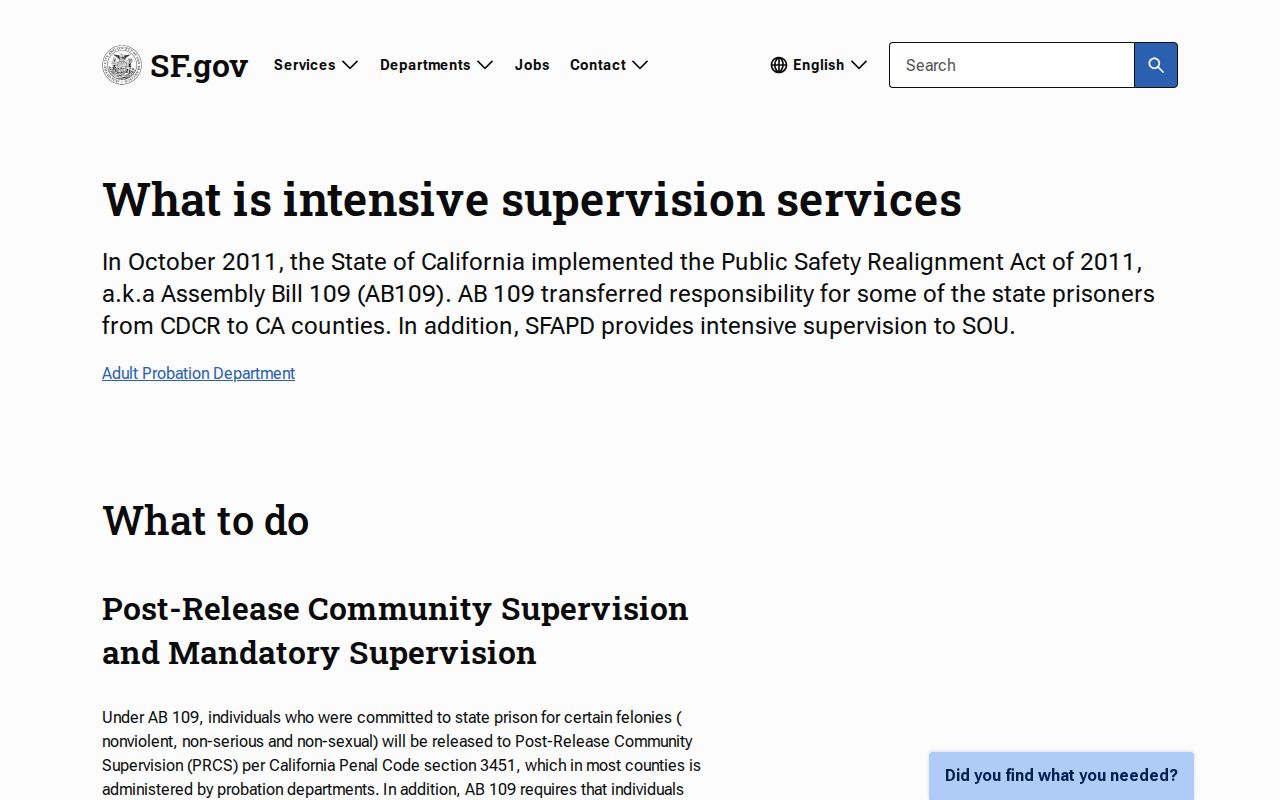
That local PRCS source is separate from BPH. Use it when the question is county supervision after release, not whether CDCR or BPH granted parole.
San Francisco Supervision Discharge
Supervision ends through discharge, court order, completion of the term, or another agency-specific action. A jail release proves that physical custody ended at that time. It does not, by itself, prove that parole, probation, PRCS, or electronic monitoring ended. The best record is the one issued by the agency with control over the supervision term.
For county probation, the Superior Court record can show disposition, sentence, probation hearings, violations, and termination. For CDCR parole, DAPO and CDCR records are the better path. For PRCS, Adult Probation and the court record should be checked together. For electronic monitoring, match the court order with the Sheriff's program record.
California record-cleanup laws can affect public access after release, but they do not rewrite the original supervision path. Penal Code section 1203.4 addresses dismissal relief after qualifying probation matters, and Penal Code section 851.91 addresses sealing arrest records after nonconviction. Use those subjects only to understand access limits and record status.